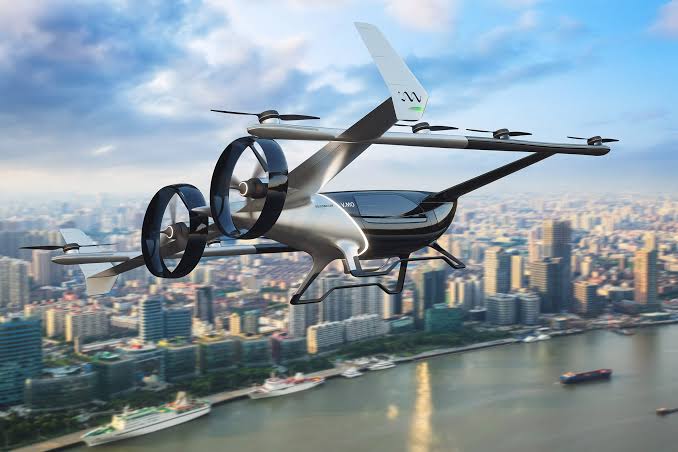
Volkswagen’s attempt to build a luxury flying car in China has ended not with a commercial launch, but with a cancelled program, accusations of intellectual-property theft, a $30 million lawsuit and a criminal investigation involving the executive who led the project.
The story, revealed in a July 30, 2026 investigation by Reuters, offers a rare look inside one of the German automaker’s most ambitious technology experiments. Volkswagen wanted to create an electric vertical takeoff and landing aircraft, commonly known as an eVTOL, for wealthy Chinese customers. The aircraft was intended to carry four passengers and luggage between major urban areas while producing less noise than a conventional helicopter.
Instead, the project became an example of how quickly China’s mobility industry is changing—and how even one of the world’s largest automakers can struggle when entering an aviation market dominated by fast-moving local companies.
The controversy also reverses a familiar narrative. Western companies have long warned about the risk of technology being copied in China. In this case, a Chinese aviation startup has accused Volkswagen and a Chinese aerospace company of improperly using or sharing its proprietary work. Volkswagen rejects the allegations and says the claims against it are without substance.
Volkswagen began exploring its Chinese flying-car project in 2019, when the commercial eVTOL sector was still relatively open. The company assembled a small innovation team in Beijing and set out to create a futuristic aircraft designed specifically for China.
The target audience was not the mass market traditionally associated with Volkswagen. Internal planning documents reviewed by Reuters described potential buyers as wealthy consumers seeking exclusivity, advanced technology and status. The proposed aircraft would provide space for four passengers and their luggage, with a premium cabin and entertainment screens.
Volkswagen publicly introduced the V.MO prototype in July 2022. In its official announcement, the company described it as a fully electric passenger drone and said an eventual production version could travel up to 200 kilometers.
The prototype used eight rotors for vertical lift and two propellers for forward flight. Its black-and-gold appearance inspired the nickname “Flying Tiger,” referring to the Chinese Year of the Tiger.
Volkswagen Group China’s own project interview said the aircraft could eventually serve business and leisure travelers moving between China’s large megacity regions.
Because Volkswagen’s small Beijing team did not have deep aviation experience, the automaker sought Chinese partners to help evaluate and develop the aircraft.
One was Pantuo Aviation, a young Shanghai-based company led by entrepreneur Zhang Qiong. Pantuo was hired to study the feasibility of a Volkswagen-branded luxury aircraft. Its proposed Pantala design reportedly featured four rotating wings and a dramatic, futuristic appearance that impressed Volkswagen managers.
The relationship deteriorated after technical concerns emerged. According to Reuters, Volkswagen and an aviation consultancy connected to Aviation Industry Corporation of China found serious risks involving aerodynamics, projected range and aircraft weight.
Pantuo’s leadership believed Volkswagen underestimated the complexity of designing a new aircraft and approached the work too much like a conventional vehicle program.
Volkswagen eventually restarted the design process with other partners. That decision led to a dispute over the Pantuo contract and, more importantly, over what happened to the startup’s designs and research. An arbitration ruling in April 2023 favored Volkswagen and ordered Pantuo to pay more than $120,000 in damages and fees, but the conflict continued.
The legal battle escalated in September 2025, when Pantuo filed a $30 million lawsuit in a Guangdong court against Volkswagen and AVIC General Huanan Aircraft Industry Company, identified in Reuters’ reporting as AVIC GA.
Pantuo alleged that Volkswagen shared details of its flying-car work with AVIC GA, which the startup considered a competitor. The claim centered on alleged intellectual-property theft and the handling of Pantuo’s proprietary research.
These are allegations, and Volkswagen denies wrongdoing. AVIC did not respond to Reuters’ questions about the lawsuit involving its unit.
In June 2026, China’s Supreme People’s Court dismissed Pantuo’s lawsuit against Volkswagen on procedural grounds, concluding that the claim against the automaker should have been handled through arbitration. The ruling allowed the case against AVIC GA to continue and left open the possibility that Pantuo could return to arbitration against Volkswagen.
The ruling did not prove Pantuo’s allegations, nor did it finally resolve the underlying dispute.
The most serious personal consequences have fallen on Zhou Jin, the Chinese executive who led Volkswagen’s flying-car initiative and appeared in company promotional material.
According to documents reviewed by Reuters, Shanghai authorities opened a criminal investigation into alleged trade-secret infringement, and Zhou was named as the suspect when the probe began in December 2023. Shanghai prosecutors took up the case in 2024.
Reuters reported that Zhou has faced travel restrictions during the investigation. She said she had been carrying out her duties as a Volkswagen employee and expressed frustration that the company treated the case as an individual legal matter. Pantuo’s Zhang said her complaint had been directed at Volkswagen, not Zhou personally.
Volkswagen declined to discuss the criminal case in detail while maintaining that the broader claims against the company lacked substance. The criminal investigation remains separate from the civil lawsuit.
Despite the breakdown with Pantuo, Volkswagen did not immediately abandon the flying-car concept. It selected Hunan Sunward Technology, a Chinese manufacturer of drones and light aircraft, to help create a new full-scale prototype.
That collaboration produced the Flying Tiger configuration unveiled in 2022. Volkswagen and Sunward later developed additional prototypes, including a luxury-cabin model called “Sky Garden.” The mock-up received high-level attention and was later taken to Volkswagen’s Wolfsburg headquarters for an executive review.
Volkswagen then worked with Wanfeng Auto Holding Group to explore commercialization. In March 2024, a Volkswagen management committee allowed the program to move forward, although legal, financial and strategy teams had raised concerns about risk, profitability and competition.
The final decision rested with Volkswagen’s China chief, Ralf Brandstaetter. In June 2024, he ended the project and disbanded the team as the company faced falling passenger-car sales and pressure to concentrate on its core automotive business.
While Volkswagen debated technical and commercial risks, Chinese competitors accelerated.
China has made the “low-altitude economy”—including drones, air taxis and aviation services operating in lower airspace—a national strategic priority. Government support, specialized supply chains, testing infrastructure and local investment have helped Chinese eVTOL developers move quickly.
At least seven Chinese companies were expected to offer eVTOL vehicles by the end of 2026, according to data cited by Reuters. One of the most visible competitors is Xpeng’s flying-car business, Aridge.
In April 2026, Xpeng President Brian Gu told Reuters that the company expected large-scale production in 2027, with initial deliveries potentially beginning in late 2026. Xpeng had received more than 7,000 orders, mostly in China, while pursuing aviation approval.
The competitive irony is clear: Xpeng is also a major Volkswagen partner in conventional electric vehicles. Volkswagen depends on the Chinese automaker for parts of its China EV strategy, while Xpeng’s affiliated flying-car operation advances in a market Volkswagen exited.
Volkswagen’s decision to cancel V.MO cannot be separated from pressure on its main automotive operations.
The company once dominated China’s passenger-car market, but domestic manufacturers have gained ground in electric vehicles, software, driver-assistance technology and connected-car features. Reuters reported that Volkswagen’s annual deliveries in China had fallen from approximately 4.2 million vehicles in 2019 to about 2.7 million in 2025.
The decline continued in 2026. Volkswagen’s global deliveries dropped 8.6% during the second quarter, while deliveries in China fell 36.6% from a year earlier. The company cited weakness in the overall Chinese market, while analysts also pointed to Volkswagen’s underperformance.
Those numbers help explain why management was unwilling to finance a long-term aviation program with uncertain profitability. The flying car offered prestige, but Volkswagen’s immediate challenge was defending its position in conventional and electric vehicles.
The Flying Tiger’s collapse highlights three changes reshaping the global automotive industry.
First, expertise in car manufacturing does not automatically transfer to aviation. An eVTOL must meet demanding requirements involving weight, aerodynamics, batteries, redundancy, flight controls, certification and passenger safety. Volkswagen had enormous engineering resources, but it still needed specialized aviation partners.
Second, speed has become a strategic advantage in China. Large global corporations often rely on lengthy approval, compliance and risk-management procedures. Chinese startups may be able to test, redesign and commercialize products more rapidly, especially in industries supported by national policy.
Third, the intellectual-property balance is evolving. Chinese technology companies increasingly possess valuable original research and are more willing to enforce their rights against foreign partners. Whatever the final legal outcome, the Pantuo dispute shows that Western businesses can now face Chinese IP claims as defendants, not only as plaintiffs protecting their own technology.
Volkswagen has not announced plans to revive V.MO. Its China strategy is now more focused on electric vehicles, software, autonomous-driving systems and partnerships with companies such as Xpeng and Horizon Robotics.
Pantuo may continue pursuing its options through arbitration or through the remaining case against AVIC GA. The criminal investigation involving Zhou also remains unresolved according to the latest public reporting.
Meanwhile, the flying-car race continues, but the sector remains risky. Even a technically successful aircraft must overcome regulatory certification, infrastructure requirements, high costs, public acceptance and uncertain demand.
Volkswagen’s experience does not prove that flying cars have no future. It does show that an impressive prototype and an ambitious press release are far removed from creating a legally secure, certifiable and profitable aviation business.
The Flying Tiger began as a symbol of Volkswagen’s ambition to reinvent mobility in China. It ended as a warning about entering an unfamiliar technology sector while depending on outside partners and navigating a fast-changing legal environment.
For Volkswagen, the failed program raises questions about whether traditional automakers can move quickly enough to compete with China’s technology-driven mobility companies. For Pantuo, the dispute is an effort to defend research it says was improperly shared. For Zhou Jin, it has become a personal legal crisis linked to work she says she performed for her employer.
The most controversial element is not simply that Volkswagen’s flying car never reached customers. It is that a program designed to showcase German engineering and Chinese innovation now stands at the center of a trade-secret dispute that has reversed the traditional roles in China’s intellectual-property debate.